How to Write SOPs for a Woodworking Shop (With a One-Page Template)
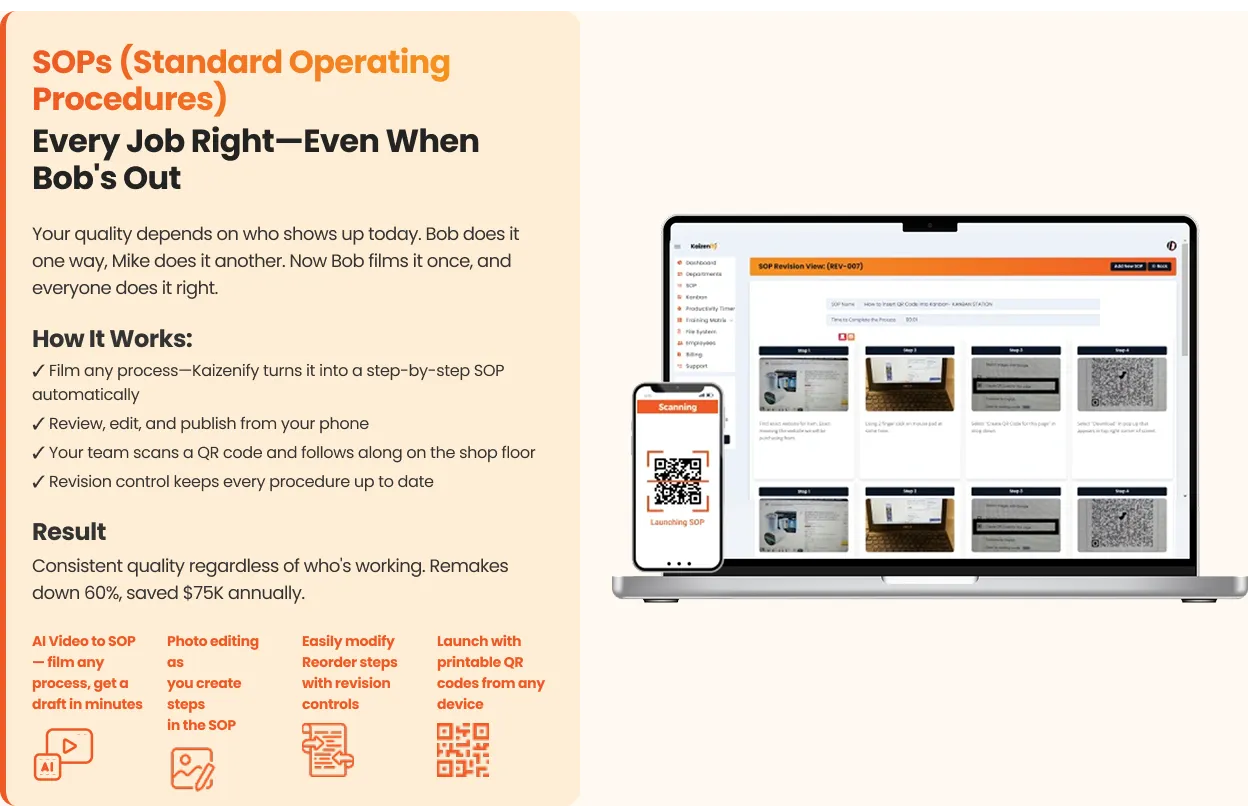
Every shop has an SOP problem, and it's usually not that they don't have SOPs. It's that the ones they have are three pages of text in a binder nobody opens, written once by someone who's since left. The job gets done the way whoever's on the machine that day remembers, and when Bob's out, it gets done differently.
A standard operating procedure in a woodworking shop has one job: the task gets done the same way, correctly, regardless of who does it. Here's the format that achieves that, how to make one in under an hour, and which one to write first.
What an SOP is for in a shop
Not compliance. Not documentation for its own sake. Consistency: the edgebander gets set up the same way every time, the drawer box gets glued and squared the same way, the finish gets mixed the same way. That consistency is what makes quality predictable, training fast, and the shop able to run when a key person is out.
If an SOP doesn't change how a job gets done on the floor, it isn't working, no matter how thorough it looks.
The one-page format
Everything on one page. If it doesn't fit, it's two SOPs, or it has too much in it.
- Title — the task, in the words the crew uses. "Set up the edgebander for 3mm PVC," not "Edgebanding Procedure 4.2."
- Why it matters — one line. "Wrong glue temp causes chip-out at assembly." This is the line that makes people follow it.
- Tools and materials — a short list, so nobody starts and then goes hunting.
- Steps with photos — five to eight steps, each with a photo of the actual station and a short line. Photos over paragraphs, every time.
- The check — what "done right" looks like, and how to tell in ten seconds. Usually one photo and one measurement.
- Owner and date — who maintains it and when it was last updated.
That's it. No revision history table, no sign-off matrix on the page itself. That lives elsewhere.
Photo-first: film it in three minutes
The fastest way to make an SOP is to have the person who does the job best do it once while you film on a phone and they talk through it. Three minutes of video contains every step, every photo you need (screenshots), and the words to use. Pull the frames, write one line per step, done.
If you'd rather skip the pulling and writing, that's what AI Video to SOP does: film the walkthrough, and it drafts the step-by-step SOP with the frames pulled out — you edit rather than write.
Where SOPs live: at the workcell, not in a binder
An SOP in the office does nothing. Put it where the job happens: a QR code at the station that opens the SOP on a phone, or a laminated one-pager clipped at the machine. The QR version wins because updates go live instantly and photos and video work; the laminated version is fine to start.
The test: can the person at the machine open the right SOP in five seconds without leaving the station? If not, move it.
Versions and training sign-off
Two things keep SOPs honest over time. First, when the SOP changes, everyone who does that job needs to know — which is easy when it's digital and hard when it's a binder. Second, keep a simple record of who has been trained on which SOP. That record is a training matrix, and it's how you know who can cover a station when someone's out; we cover how to build one in the skills matrix template.
Which SOP to write first
Not the one that's easiest. The one behind your most expensive defect. Run a defect log for two weeks, rank by cost, and write the SOP for the job that produced the number-one defect. That SOP pays for itself immediately, and it shows the crew what an SOP is for.
Then the next one. One a week is a sustainable pace; forty in a month is how the project dies.
Template
The one-page template has the six sections above laid out to print, with placeholders for photos, and a Word version you can duplicate per task. Free, no email.
When to move SOPs into a system
When you have more than a dozen, when they're changing, when you want the QR code and the training record connected, or when you'd rather film than write. Kaizenify's SOP tool holds SOPs with photos and video at a QR code per workcell, and if writing is the bottleneck, our done-for-you program builds the first set with your team.
Frequently asked
How do you write an SOP for a manufacturing process? One page: title in the crew's words, why it matters, tools, five to eight photo steps, and the final check. Film the best person doing it, pull the frames, write a line per step.
How long should an SOP be? One page. If it doesn't fit, split it into two tasks.
Where should SOPs be kept? At the workcell — a QR code or a laminated page at the machine. Not in the office.
Which SOP should we write first? The one for the job that causes your most expensive defect. Rank defects by cost first.
Lynn
Co-founder, Kaizenify
Co-founder of Kaizenify. Works with cabinet and millwork shops on lean daily management.