Ask a shop owner what defects cost them and you'll usually get a shrug and a guess: "a few thousand a month, maybe." Ask them to add it up and the number is almost always bigger, sometimes by a multiple. That gap between the guess and the real figure is the cost of poor quality, and it's the most recoverable money in most small shops because nobody has been managing it.
This post gives you a way to calculate it that a shop can actually maintain, a worked example so you can see the scale, and the one place to start.
What "cost of poor quality" means in a shop
Cost of poor quality (COPQ) is everything you spend because work wasn't right the first time. In a cabinet or millwork shop that breaks into a handful of buckets:
- Rework: the hours to fix a part or an assembly. Re-sanding, re-edgebanding, re-drilling, refinishing.
- Scrap: material thrown away. The sheet cut wrong, the door that can't be saved, the drawer box that came out of square.
- Remakes: a rework so big it's a new job. Often shows up after install.
- Downtime caused by defects: the cell waiting while a part is remade or a machine setup is corrected. This is the bucket most people forget and it's frequently the largest.
- Expedite and freight: rush material, overnight hardware, an extra truck to the job site.
- Warranty and service calls: the drive back to the customer, the tech's day, the replacement part.
- The throughput you didn't produce: every hour of rework is an hour that didn't produce new work. This one is real but harder to count, so it's noted separately below.
The first six are direct costs you can add up from what you already know: hours, materials, invoices. Start there.
The formula (kept simple on purpose)
Per defect:
Cost of one defect = rework hours × loaded labor rate + scrap material + remake cost + downtime hours × loaded labor rate + expedite/freight + service costs
Per period:
COPQ = the sum of that across every defect logged in the period
"Loaded labor rate" is what an hour on the floor actually costs you: wage plus benefits plus payroll taxes, roughly. Use one blended number; precision doesn't matter here. Scale does.
You'll notice the formula depends on one thing: logging every defect with a few fields attached. That's the whole method, and it's why shops that don't log don't know their number.
A worked example (illustrative)
Numbers below are made up to show the shape of the calculation, not a claim about any shop.
A 12-person shop, loaded labor rate of $38/hour, logs defects for two weeks and finds:
| Defect | Times | Rework hrs | Scrap | Downtime hrs | Other |
|---|---|---|---|---|---|
| Edgebanding chip-out on melamine | 9 | 0.5 each | $12 each | 0.25 each | — |
| Doors out of square at assembly | 4 | 1.5 each | $45 each | 1.0 each | — |
| Wrong hardware drilled | 3 | 1.0 each | $8 each | 0.5 each | $60 rush hardware once |
| Finish run on face frames | 2 | 3.0 each | $30 each | 2.0 each | — |
Two weeks of cost:
- Edgebanding: 9 × (0.5 × 38 + 12 + 0.25 × 38) = 9 × 40.50 = $364.50
- Doors: 4 × (1.5 × 38 + 45 + 1.0 × 38) = 4 × 140 = $560
- Hardware: 3 × (1.0 × 38 + 8 + 0.5 × 38) + 60 = 3 × 65 + 60 = $255
- Finish: 2 × (3.0 × 38 + 30 + 2.0 × 38) = 2 × 220 = $440
Two-week COPQ: about $1,620. Annualized: roughly $42,000 for a 12-person shop, before counting the throughput those rework hours didn't produce, and before a single service call.
Two things jump out. First, the number is real money in a shop that "didn't really have a quality problem." Second, the biggest single line isn't the most frequent defect. Edgebanding chip-out happens most; doors out of square costs most. That distinction is why you log, and it's exactly what to fix first.
Where the cost hides
The reason owners underestimate COPQ is that most of it never shows up as a line item:
- Rework is invisible on the time sheet. It's just hours. Nobody codes "re-did the drawer fronts."
- Downtime is blamed on something else. The cell that waited 45 minutes for a remade part gets called slow, or the schedule gets called tight.
- Scrap goes in the bin. A quarter sheet here, a door there. Nobody adds up the bin.
- Service calls feel like customer service. They're quality cost.
- Found vs. caused is never separated. A defect found at assembly that originated at the saw gets counted, if at all, against assembly. The saw never sees the number, so it never changes.
That last one is the difference between tracking defects and reducing them. Log where a defect was found and where it was caused. Cost lands on the cell that generated it, and that cell can fix it.
The one place to start
Don't try to build a quality program. Do this:
- For two weeks, log every defect. Where found, where caused, what happened, rework hours, scrap, downtime. A clipboard at each cell works to start.
- At the end of two weeks, run the formula above on each defect type. Sort by total cost.
- Fix the top one. Just the top one. Root cause it, change the setup or the SOP or the check, and keep logging.
- Repeat.
That's how one shop recovered $40,000 in a single month: the log pointed at one recurring issue nobody had prioritized because it wasn't the loudest problem, only the most expensive. For a smaller shop, one owner's estimate is $3,000 or more a week in recoverable downtime once defects are visible. Your number will be your own; the method is the same.
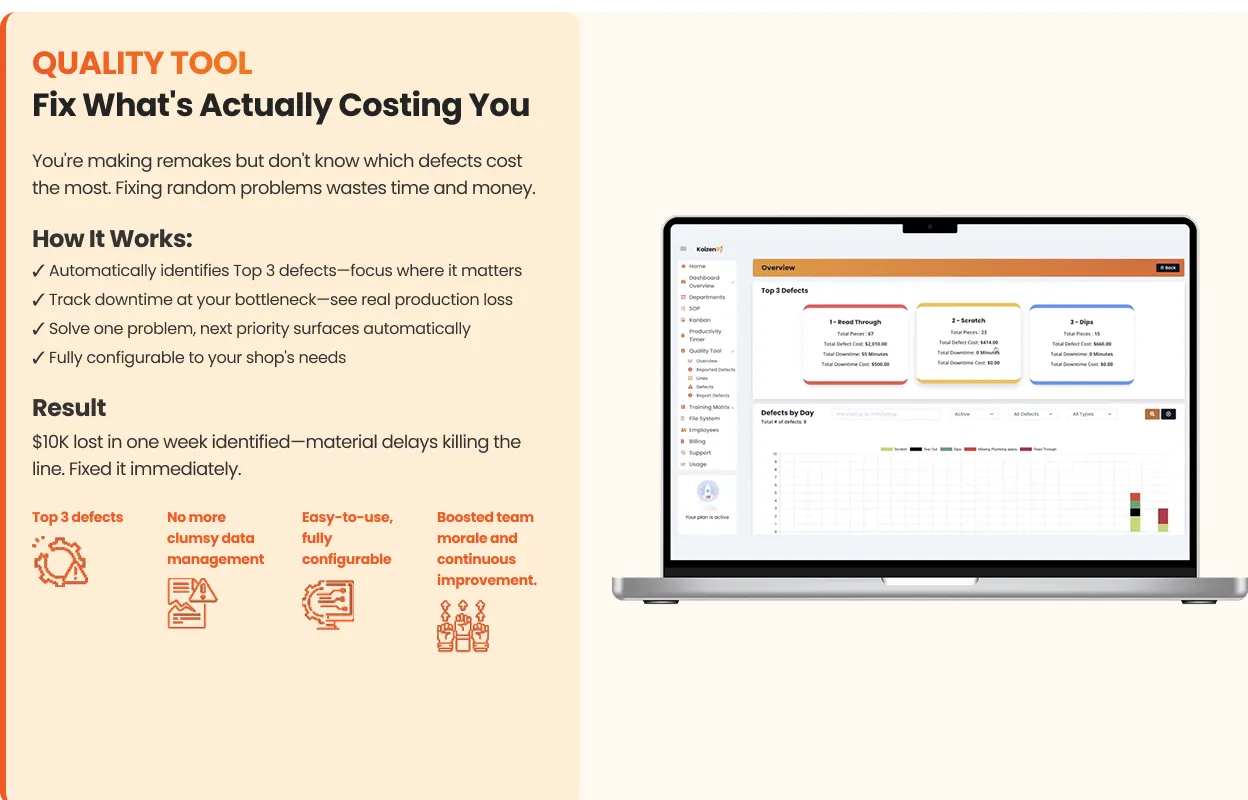
If you'd rather not run this on a clipboard, Kaizenify's quality tracking logs defects at the cell with found/caused, rework time, and cost attached, and shows you which issue is costing the most, and it feeds the same throughput dashboard the rest of the shop runs on.
Frequently asked
Is COPQ the same as scrap rate? No. Scrap is one bucket. Rework hours and downtime are usually larger than scrap in a custom shop.
How accurate does the labor rate need to be? Roughly right. The decisions come from the ranking of defect types, not the exact dollar figure.
We only have a few defects a week. Is it worth tracking? The example above is a shop with a few defects a week. Yes.
Where do we record a defect: where it's found or where it was caused? Both, on the same entry. Found tells you where to catch it sooner; caused tells you where to prevent it.
Lynn
Co-founder, Kaizenify
Co-founder of Kaizenify. Works with cabinet and millwork shops on lean daily management.