Skills Matrix Template for Manufacturing Teams (Training Matrix Explained)
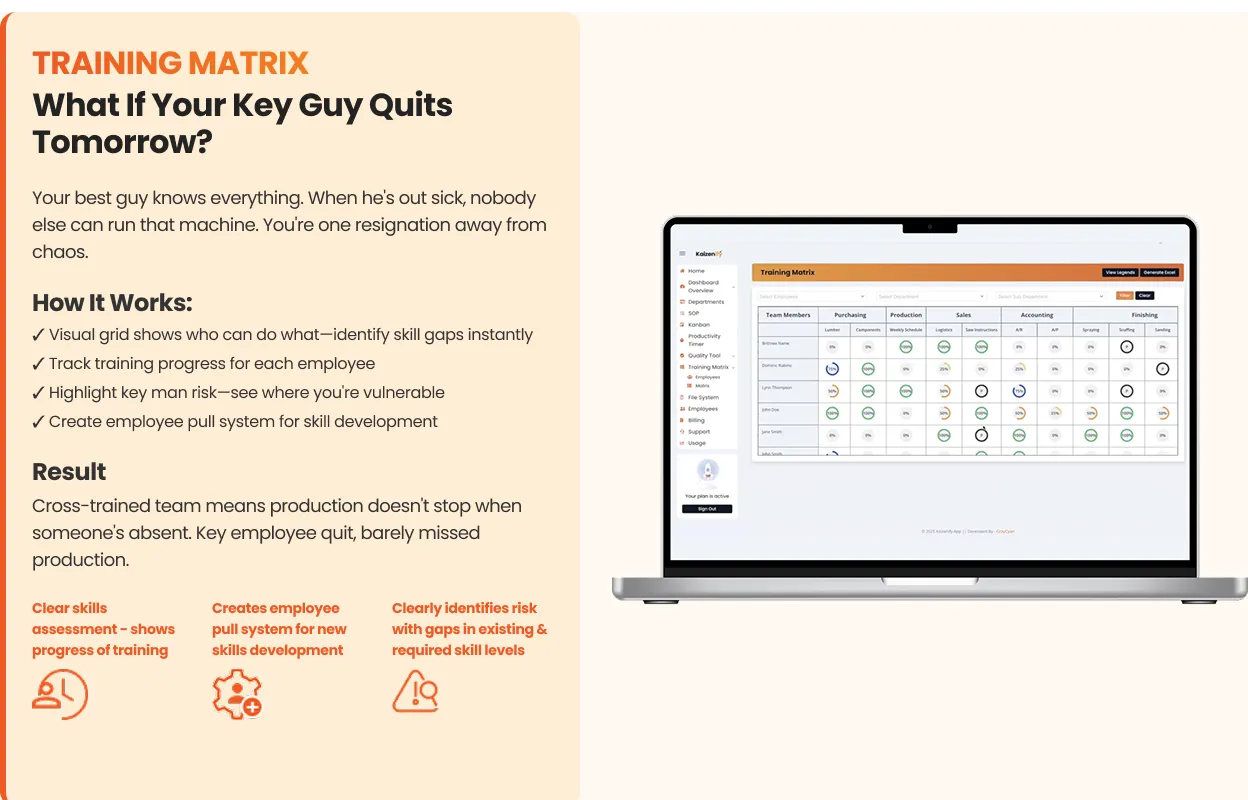
A skills matrix — also called a training matrix — is a grid: people down the side, tasks or SOPs across the top, and in each cell a mark for how well that person can do that task. It answers the question every shop owner asks the morning someone calls in sick: who else can run that station?
Here's the version that works in a cabinet or millwork shop, the four-level scale that keeps it honest, how to read it, and a template.
What a skills matrix is
Rows are people. Columns are the tasks the shop depends on — ideally the same list as your SOPs, so "trained on the task" and "trained on the SOP" mean the same thing. Each cell says where that person is on that task.
That's the whole tool. Its value is that it makes visible what usually lives in the owner's head: who can do what, and where the shop is one absence away from a stopped station.
The four levels
Keep the scale simple and the same for every cell:
- 0 — Can't do it. Blank cell.
- 1 — Learning. Has been shown; needs supervision.
- 2 — Can do it. Works the station to standard, unsupervised.
- 3 — Can train others. Does it to standard and can teach it.
Some shops draw it as a quartered circle filled in by level. Numbers work fine in a spreadsheet. The line that matters is between 1 and 2 — that's "counts as coverage" — and it should mean "signed off on the SOP," not "has done it a couple of times."
Rows = people, columns = SOPs
Start the column list from your SOPs if you have them, and from "the tasks the shop stops without" if you don't: saw, CNC, edgebander setup, drawer box assembly, door assembly, finish mixing, spray, install. Ten to twenty columns is typical for a small shop. Don't list every micro-task; list the stations and jobs that need coverage. Writing the SOPs first makes this easy — see how to write SOPs for a woodworking shop.
Filling it in honestly
Do it with the lead or the person themselves, not from memory in the office. The temptation is to give everyone a 2 because they've "done it before." Ask instead: would you leave them alone on that station on a rush day? If the answer's no, it's a 1. An honest matrix with more 1s than you'd like is worth more than a flattering one.
Reading it: single points of failure
Once filled in, count down each column: how many people are at 2 or 3? Any column with one is a single point of failure — the shop stops if that person is out. Any column with zero at 3 means nobody can train the next person.
Those columns are your cross-training priorities. Pick the one or two most critical stations with the thinnest coverage, choose who to bring from 1 to 2, and put a date on it. That's the plan; the template has a tab for it.
Keeping it current
A matrix goes stale the moment training happens and nobody updates the sheet. Two habits fix that: when someone signs off on an SOP, the cell moves that day; and once a month, look at the coverage counts in the huddle. If SOPs and the matrix live in the same system, the sign-off can update the cell for you — that's how the training matrix tool works, alongside the SOPs it tracks.
Template
The spreadsheet has the people × SOPs grid with the four-level scale, coverage counts per column, and a cross-training plan tab; the PDF is a printable blank for the wall. Free, no email.
Frequently asked
What is a skills matrix in manufacturing? A grid of people versus tasks or SOPs, with each cell showing that person's level on that task. It shows who can cover which station.
What's the difference between a skills matrix and a training matrix? Mostly terminology. Both map people to tasks and levels; "training matrix" often emphasizes who's been trained on which SOP, which is exactly how a shop should build it.
How many levels should a skills matrix have? Four is enough: can't, learning, can do, can train. The important line is between "learning" and "can do."
How often should it be updated? The day someone signs off on an SOP, and reviewed monthly for coverage gaps.
Lynn
Co-founder, Kaizenify
Co-founder of Kaizenify. Works with cabinet and millwork shops on lean daily management.