Shop Floor Management: What It Is and How Small Shops Do It
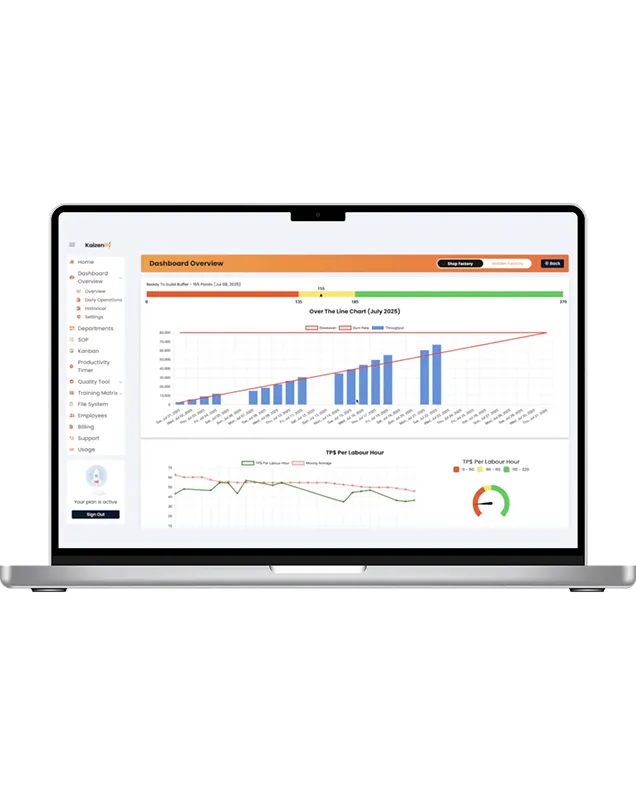
Shop floor management is the set of daily habits that decide whether a shop hits its numbers: what gets measured, when people look at it, and what happens when something's off. Big plants have departments for it. Small shops usually have an owner walking the floor, a whiteboard that's half up to date, and a gut feel that's right more often than not — until it isn't.
This guide is for the second group: custom cabinet, millwork, and small manufacturing shops with anywhere from one to two hundred people on the floor. It covers what shop floor management actually includes, how it differs from the software categories it gets confused with, and the daily routine that makes it work without adding a manager.
What shop floor management covers
At its simplest, it's five things, managed every day:
- Flow — is work moving through the shop at the rate it needs to? (Throughput against a daily target.)
- Quality — what's being redone or scrapped, and what's it costing?
- Material — do the cells have what they need, or is someone waiting or driving to a supplier?
- People — who's trained on what, who's covering, and where are the hours actually going?
- Information — does the person at the machine know how to do this job the standard way, without asking?
Everything else — the boards, the software, the meetings — exists to keep those five visible and to trigger action when one slips.
Shop floor management vs. scheduling vs. ERP
This is where small shops get sold the wrong thing. Three different jobs get lumped together:
Scheduling decides what runs when — sequencing jobs, promising dates, loading machines. It's a planning function.
ERP ties the business together — quoting, purchasing, job costing, accounting, sometimes inventory. It's a system of record.
Shop floor management is what happens today — are we on pace, what's going wrong, where should people focus this afternoon. It's a management routine, and most scheduling and ERP tools don't do it; they report on it after the fact.
A shop can run all three, but they aren't substitutes. Plenty of shops with an ERP still can't tell you at 11am whether they'll make the day. If you're trying to sort out which category you actually need, we've written a plain comparison of ERP, inventory, and job-tracking software.
The daily routine
Good shop floor management is boring on purpose. Same routine, every day:
Morning huddle (5–10 minutes). At the board or the screen. Yesterday's throughput vs. target. Any defects logged. Any stockouts or material issues. Today's target and any known risks. Who's covering what. Then go.
Mid-shift check (2 minutes, around 11am). Are we on pace? This is the check that matters most: a shop that finds out at 4:30 that it missed can't do anything about it. A shop that finds out at 11 moves people, pulls a job forward, or fixes the bottleneck.
End-of-shift entry (5 minutes per area). Actual throughput. Defects logged with where found and where caused. Hours. Any stockout. Whoever runs the area enters it — not the owner.
Weekly (20 minutes). Look at the trend, not the day. Rank defects by cost. Decide the one improvement for next week.
That's the whole system. If it takes much longer than this, it's too complicated to survive.
The numbers that make it work
You need a small set of metrics that each point to a specific action. In a custom shop that's five: throughput target vs. actual by day, on-time delivery, defects and their cost, labor productivity, and inventory health. We go through each, what it points at, and how to read them together in the five KPIs that tell you if you made money.
The single most important habit is the throughput target. Without a daily target, "how are we doing?" has no answer. With one, every other number becomes an explanation of why throughput moved.
Visual management: from the whiteboard to a screen
Shop floor management is visual by nature — the numbers have to be where people can see them. Most shops start with a whiteboard at the huddle spot: five columns, filled at end of shift, read every morning. That works, and it's the right way to start.
It stops working when the board isn't updated because someone's out, when there are two shifts and one board, when you want to see last month, or when the same defect keeps getting written down and nobody adds up what it's costing. That's the point where the board becomes a shop floor dashboard: the same numbers, entered at the cell, visible on every screen, target vs. actual by day, and the defect and stockout data feeding it automatically.
Common mistakes
- Measuring too much. Thirty KPIs means none get looked at. Five that trigger action beat thirty that don't.
- The owner enters all the data. It doesn't scale and it stops the day the owner is out. Whoever runs the area enters the area's numbers.
- No mid-shift check. End-of-day numbers are history. The 11am look is where the day gets saved.
- Tracking defects where they're found, not where they're caused. The cell that made the defect never sees it, so it never changes.
- Buying a system before running the routine. Software makes a good routine easier. It doesn't create one. Two weeks on a whiteboard first tells you what you actually need.
Where to start this week
Pick your throughput unit and set tomorrow's target. Put five columns on a board. Run the huddle, the 11am check, and the end-of-shift entry for two weeks. You'll know your bottleneck, your top defect, and your stockout list — and you'll know exactly what to improve first. If the shop is disorganized enough that even that feels like a lot, start with our four-week plan for shops that don't know where to start.
Frequently asked
What is shop floor management in simple terms? The daily routine of measuring how the floor is running — flow, quality, material, people, information — and acting on it the same day.
Is shop floor management the same as production scheduling? No. Scheduling plans what runs when. Shop floor management is checking, during the day, whether the plan is happening and fixing what isn't.
Do I need an ERP for shop floor management? No. Many small shops run excellent shop floor management on a whiteboard, then a dashboard. An ERP is a system of record; it doesn't run the daily routine.
How much time does it take? About 10 minutes in the morning, 2 at midday, 5 per area at end of shift, and 20 a week. Less than most shops spend firefighting.
Lynn
Co-founder, Kaizenify
Co-founder of Kaizenify. Works with cabinet and millwork shops on lean daily management.